
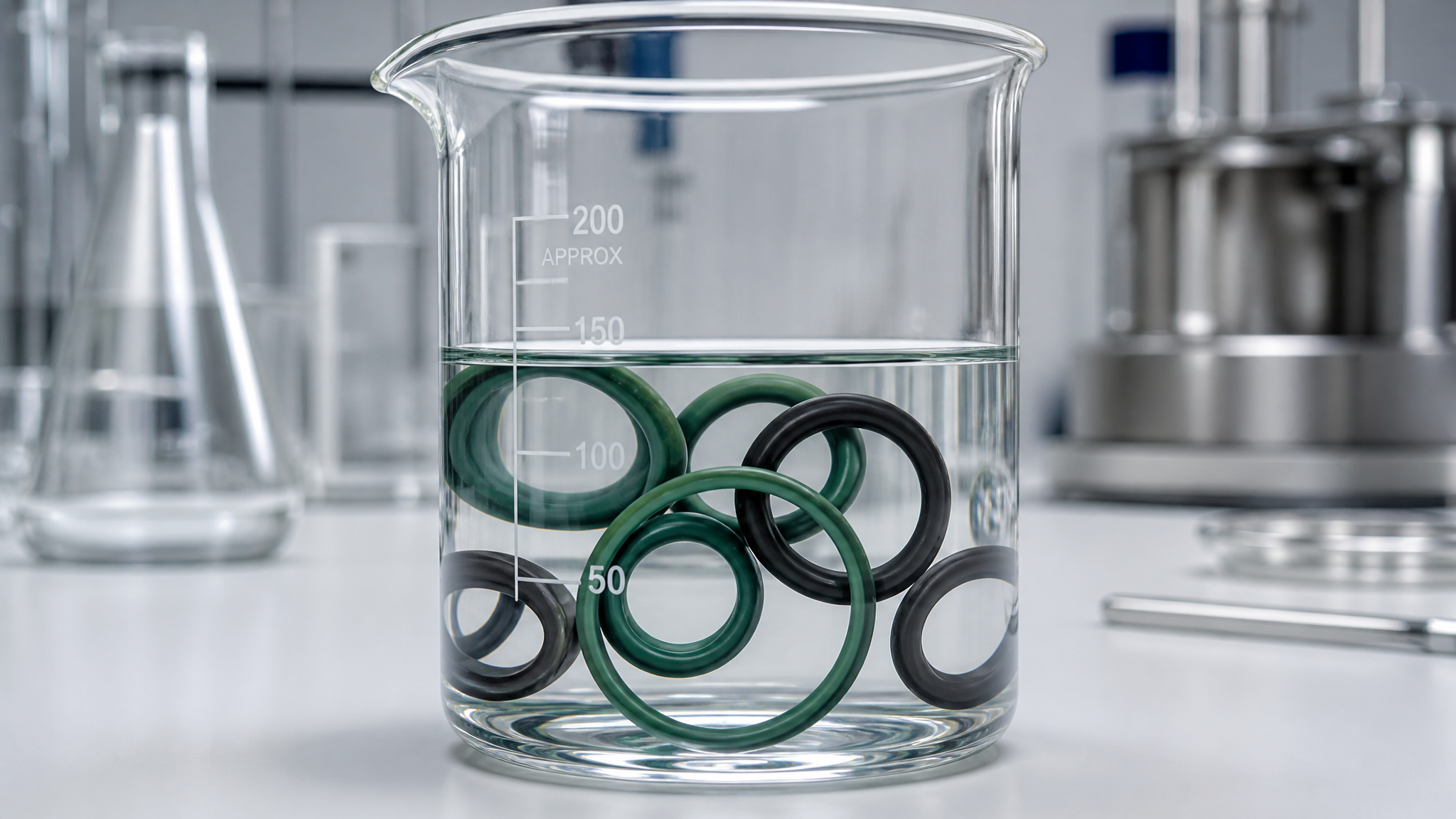
Explore the molecular science of FKM (Viton) and why it is the gold standard for sealing in harsh chemical environments. Learn how high-performance elastomers prevent multi-million dollar industrial failures.
In the industrial world, the most expensive component isn't always the largest machine—it’s the one that fails. A single seal, costing as little as $2, can lead to tens of thousands of dollars in hourly downtime, environmental fines, or catastrophic safety risks. When dealing with extreme temperatures and aggressive chemicals, standard rubbers like NBR or EPDM simply aren't enough. This is where the science of FKM (Fluoroelastomer)—widely known by the brand name Viton™—becomes the non-negotiable standard.
1. The Chemistry of Resilience: The Power of the C-F Bond
Why does FKM outperform other materials? The answer lies at the molecular level. Unlike standard elastomers that rely on Carbon-Hydrogen bonds, FKM is defined by the Carbon-Fluorine (C-F) bond.
Unmatched Bond Strength: The C-F bond is one of the strongest in organic chemistry. This high bond energy requires immense thermal or chemical energy to break, allowing the material to remain stable where others dissolve.
The "Steric Hindrance" Effect: Large fluorine atoms surround the carbon backbone, acting as an electronic shield. This prevents aggressive chemicals and oxygen from attacking the polymer chain.
2. Why FKM is Non-Negotiable in Harsh Environments
A. Universal Chemical Resistance
FKM offers exceptional resistance to a broad spectrum of chemicals, including mineral oils, aliphatic and aromatic hydrocarbons, and concentrated acids. While ordinary seals might swell or liquefy within hours of exposure to fuel or solvents, FKM maintains its integrity for months or years.
B. Thermal Stability (Up to 200°C+)
Most rubbers begin to degrade at 100°C. FKM remains functional at continuous temperatures of 200°C (392°F) and can handle intermittent spikes up to 250°C. This makes it critical for aerospace engines and high-pressure chemical reactors.
C. Low Compression Set (The "Memory" Factor)
A seal is only effective if it pushes back. "Compression set" measures a material's ability to return to its original shape after being squeezed. FKM has an incredibly low compression set, ensuring a long-lasting leak-proof seal even after years of constant pressure.
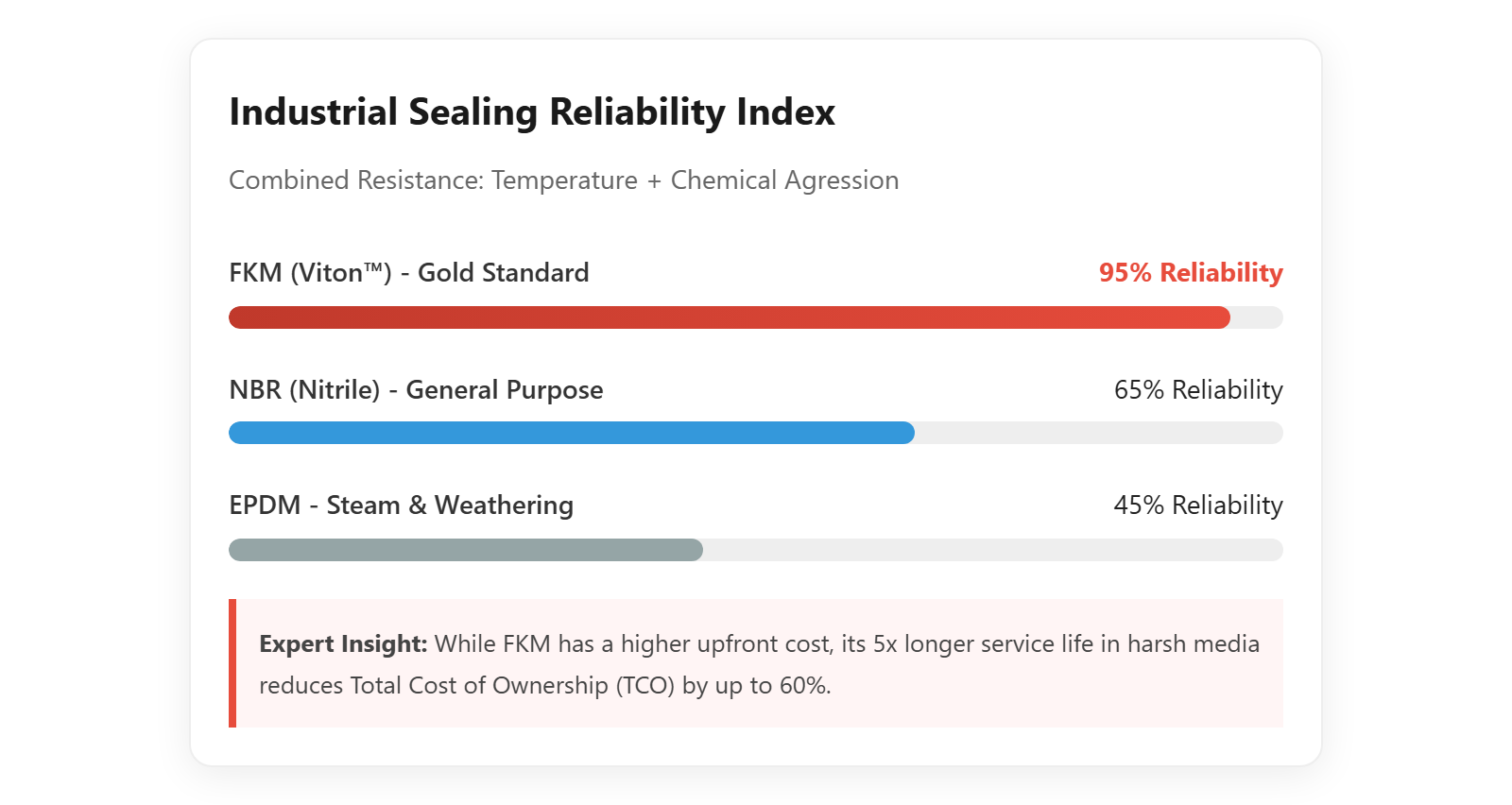
3. Material Performance Comparison
To help procurement teams visualize the ROI of FKM, here is a breakdown of performance metrics:
4. Critical Applications: Where FKM is Mandatory
Oil & Gas: Downhole tools, refineries, and exploration equipment exposed to "sour" gas (H2S).
Semiconductor Processing: Resistance to plasma, ozone, and corrosive cleaning gases in vacuum environments.
Chemical Processing: Seals for pumps, valves, and mechanical seals handling aggressive solvents and acids.
Automotive: Fuel injector O-rings and turbocharger hoses that must meet Euro 6/VI emission standards.
5. Conclusion: Managing Risk Through Material Science
Choosing FKM is not just a material choice; it is a risk management strategy. As a custom manufacturing partner with 15 years of technical expertise, we help B2B buyers navigate the complexities of polymer science to avoid costly field failures.
Need a high-precision FKM solution? We offer Shore A 50-90 hardness and tolerances as tight as ±0.05mm. Get a Technical Consultation & Quote (whatsapp +86 13356360481)
FAQ: FKM vs. Viton™
Q: Is FKM the same as Viton?
A: Yes. FKM is the ASTM (American Society for Testing and Materials) designation for the material family. Viton™ is a registered brand name of The Chemours Company.
Q: What are the main limitations of FKM seals?
A: FKM should generally not be used with ketones (like Acetone), low-molecular-weight organic acids (formic/acetic acid), or certain fire-resistant hydraulic fluids (Skydrol).
Q: What is the typical temperature range for FKM?
A: Standard FKM grades operate from -20°C to +200°C (-4°F to +392°F). Specialized "Low-Temp" FKM grades can reach -40°C.