
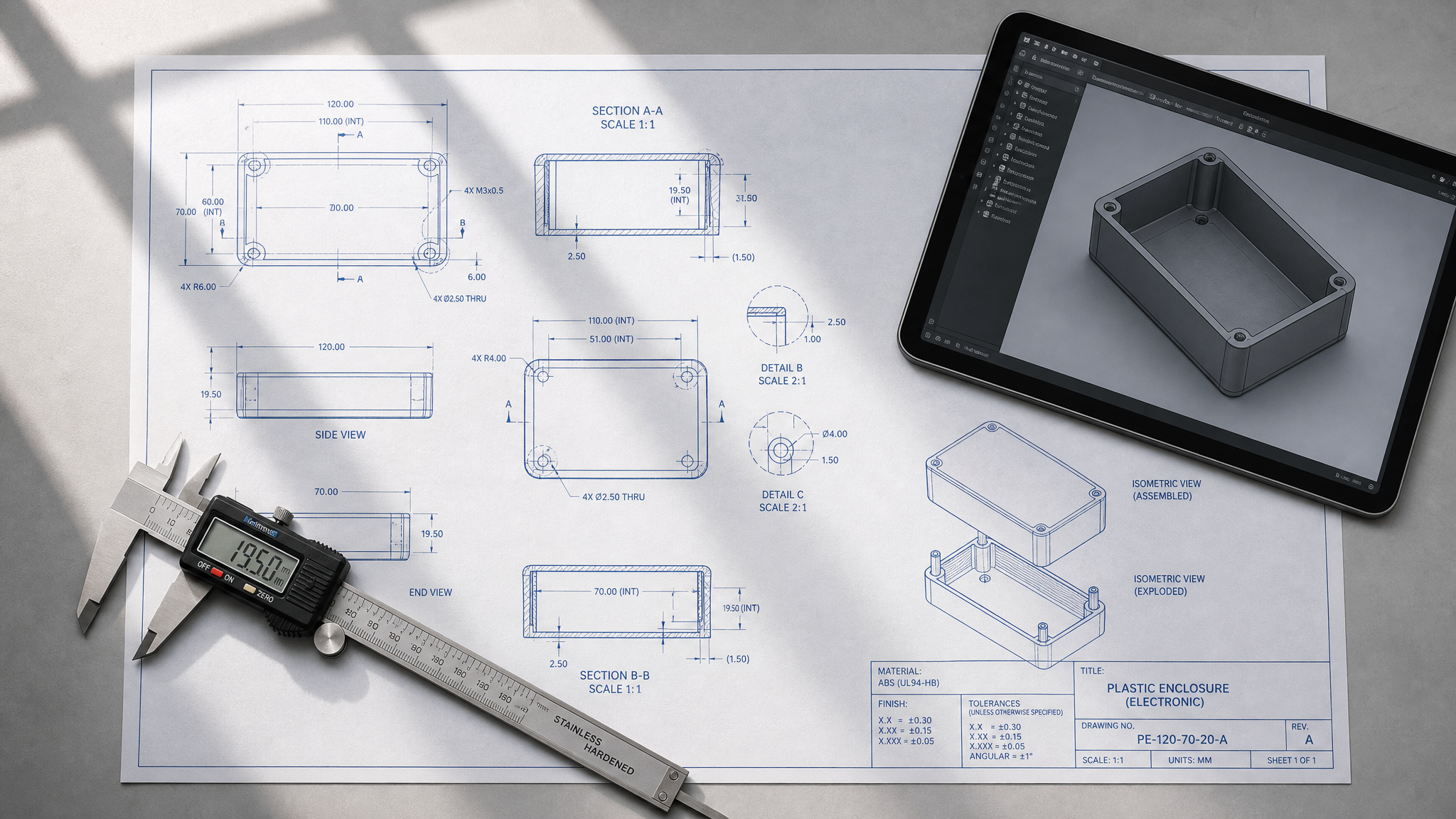
Maximize production efficiency with our DFM checklist. Learn the 5 golden rules of injection molding design—from wall thickness to draft angles—to reduce T1 iterations and unit costs.
The Silent Profit Killer: Ignored DFM
A beautiful 3D model doesn't always translate into a perfect physical part. In injection molding, design flaws that look minor on a screen can lead to warped parts, sink marks, and astronomical mold modification costs. DFM (Design for Manufacturing) is the bridge between a concept and a profitable product. Follow these 5 "Golden Rules" to ensure your T1 samples are flawless.
Rule 1: Maintain Uniform Wall Thickness
Non-uniform walls are the primary cause of warping and internal stress.
The Science: Thick sections cool slower than thin ones, leading to uneven shrinkage.
The Fix: Always aim for constant wall thickness. If transitions are necessary, use a gradual taper (minimum 3:1 ratio) to allow the melt to flow smoothly and cool evenly.
Rule 2: Respect the Draft Angle (Minimum 1.5°)
Without a draft angle, your part is essentially "stuck" in the mold.
The Requirement: A minimum draft of 1.5° to 2° is standard for most parts.
Pro Tip: If you require a textured surface (like a leather grain), you need an additional 1° of draft for every 0.025mm of texture depth to prevent drag marks during ejection.
Rule 3: Use Radii to Kill Stress
Sharp corners are the "achilles heel" of plastic parts.
The Danger: Sharp internal corners act as stress concentrators, leading to premature part failure.
The Golden Ratio: Ensure internal radii are at least 0.5 times the wall thickness. This improves resin flow and significantly increases the structural integrity of the component.
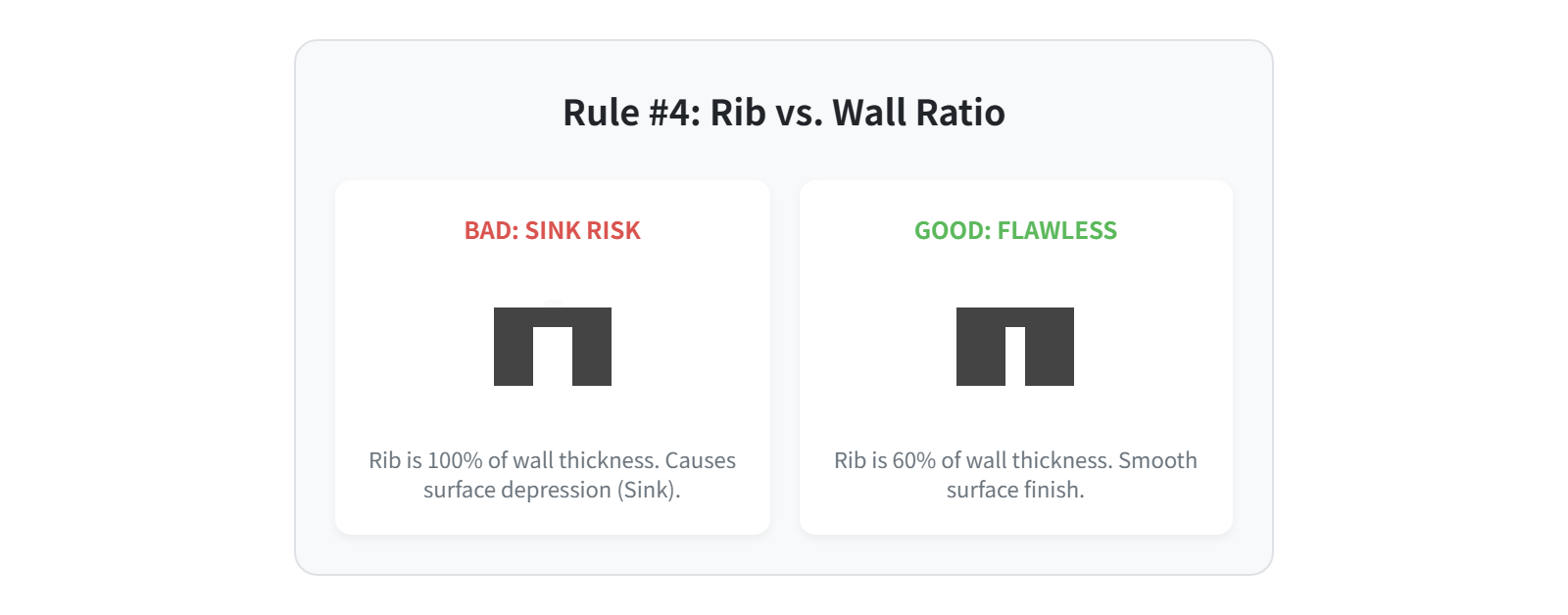
Rule 4: Master the Rib-to-Wall Ratio (The 60% Rule)
Ribs provide strength without adding mass, but if designed incorrectly, they create ugly sink marks on the visible surface.
The Rule: Rib thickness at the base should not exceed 60% of the main wall thickness.
The Benefit: This ensures the rib cools fast enough to prevent it from "pulling" the outer surface inward as it shrinks.
Rule 5: Gate Location & Flow Path (Widget)
The gate is where the polymer enters the cavity. Its location determines the strength and appearance of the part.
Conclusion: Designing for Success
Applying DFM isn't about limiting your creativity; it’s about ensuring your design survives the transition to mass production. By following this checklist, you reduce T1 iterations, lower scrap rates, and ultimately, get your product to market faster.
Planning a new injection molding project? Our engineering team provides a Free DFM Audit with every mold quote. Submit Your 3D Design for Review.
Q: What happens if I don't use a draft angle?
A: The part will create a vacuum and friction against the mold walls during ejection, causing scuff marks, warping, or even damaging the mold itself.
Q: How do I handle parts that require thick sections for strength?
A: Instead of one thick wall, use a thinner main wall supported by a network of ribs. This maintains structural strength while ensuring uniform cooling.