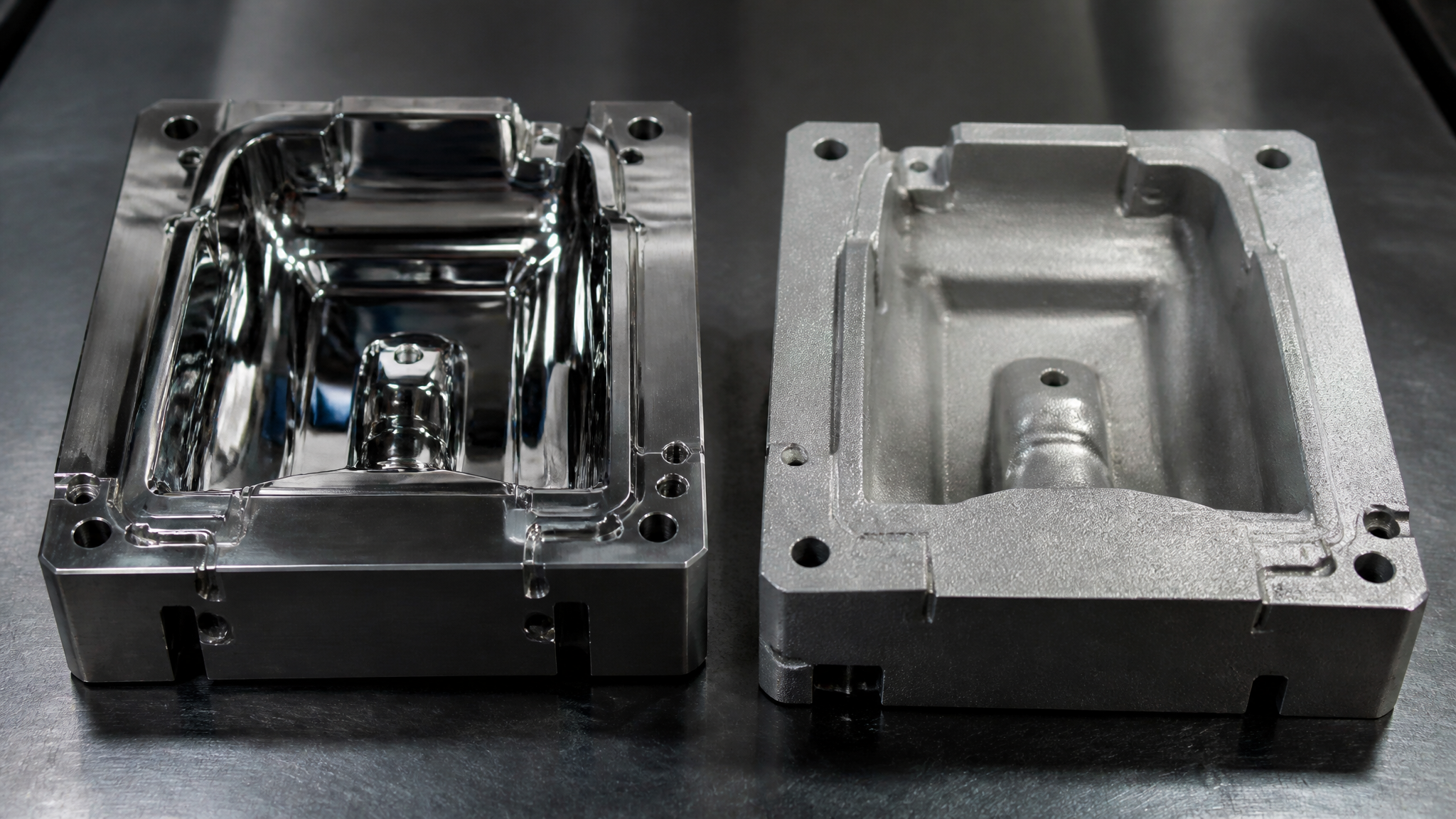
Procurement guide for PU foam and injection molding tooling. Compare the ROI of 6061 Aluminum vs. S136 Hardened Steel based on volume, cycle time, and cost-per-part.
The Procurement Trap: Upfront Cost vs. Total Cost of Ownership
For a procurement officer, a $5,000 saving on a mold quote can be a double-edged sword. If that cheaper mold increases cycle times by 10% or fails after 20,000 shots, the "saving" quickly turns into a massive loss. In the world of Polyurethane (PU) Foam and Plastic Injection, the choice between 6061 Aluminum and S136 Hardened Steel is the most critical ROI decision you will make.
1. 6061 Aluminum: The Speed King for PU Foam
Aluminum is the gold standard for PU Foam projects, particularly for medium-volume production.
Thermal Conductivity: Aluminum dissipates heat up to 4x faster than steel. In PU foam molding, where controlling the exothermic reaction is key, this leads to significantly shorter cooling cycles.
Cost Efficiency: It is easier to CNC machine, reducing initial tooling costs by 30-50% compared to steel.
Ideal for: PU armrests, seats, and flexible foam parts where the pressure is lower and volume is between 5,000 to 50,000 units.
2. S136 Hardened Steel: The Endurance Athlete
When moving into high-pressure plastic injection or massive production runs, S136 steel is non-negotiable.
Durability & Precision: With a hardness of 48-54 HRC after heat treatment, S136 can withstand millions of cycles without losing dimensional accuracy.
Surface Finish: If your part requires a "Class A" mirror finish or high-gloss transparency, S136 is the only material that can be polished to the required optical clarity.
Ideal for: High-volume plastic enclosures, medical devices, and components requiring extreme abrasion resistance.
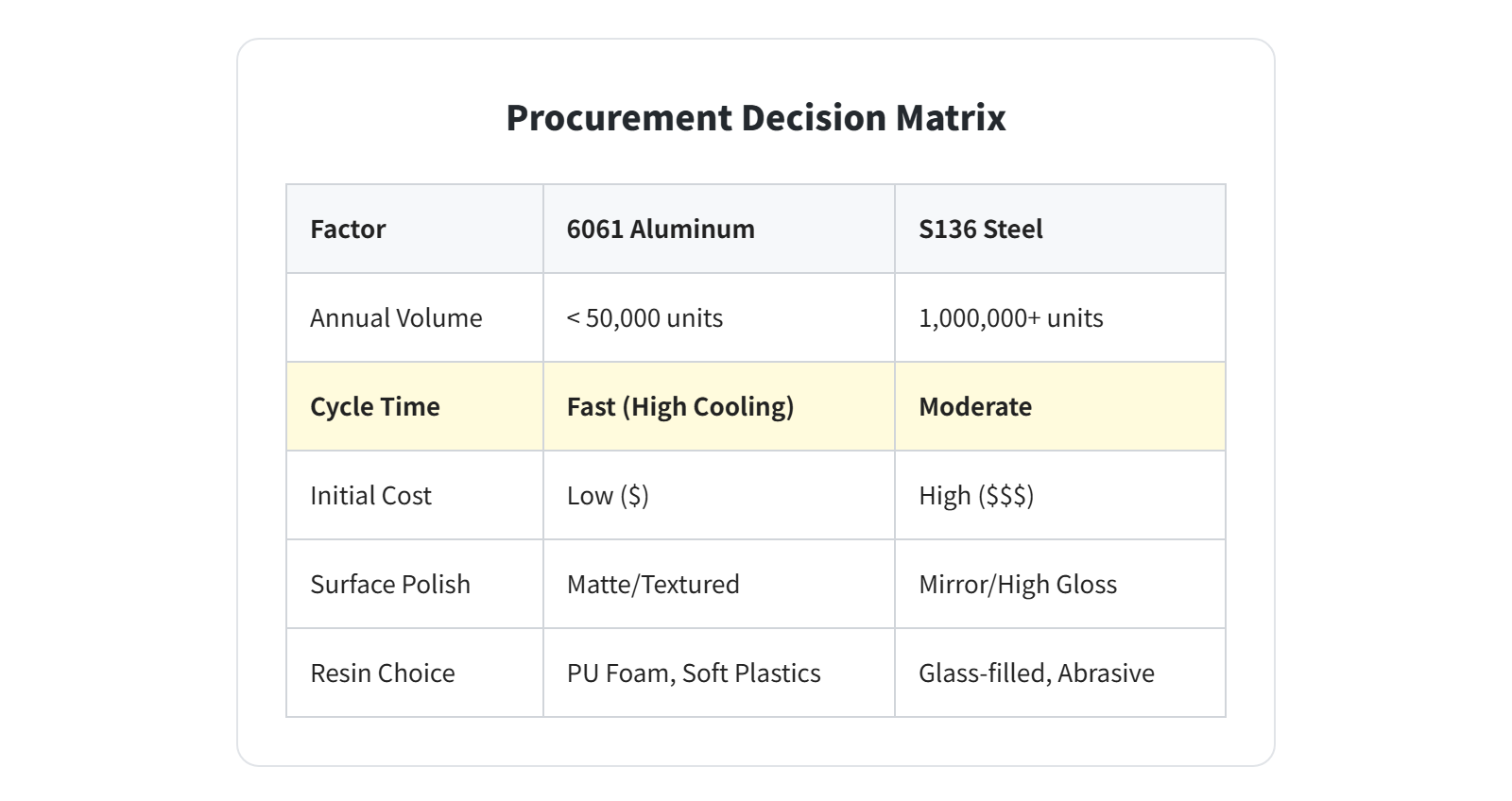
3. The Tooling Decision Matrix (Widget)
Use this matrix to determine the best ROI path for your current project:
4. ROI Summary: Choosing the Right Path
Choose Aluminum if you need to hit the market quickly, have a moderate production run, and want to minimize cooling time (lower per-part energy cost).
Choose S136 Steel if your product has a 5-year lifecycle, uses abrasive materials (like glass-filled nylon), or requires a flawless aesthetic finish.
Conclusion: Data-Driven Procurement
Investing in tooling is about balancing the Cost of Entry with the Efficiency of Scale. At our facility, we offer both specialized 6061 aluminum tooling for PU foam and high-precision S136 steel molds for injection projects.
Not sure which mold is right for your budget? Request a Tooling ROI Comparison Report at whatsapp +86 13356360481
Q: Can I run plastic injection in an aluminum mold?
A: Yes, but only for "bridge tooling" or low-volume prototypes. The abrasive nature of some plastics will wear down an aluminum mold much faster than a steel one.
Q: How much cycle time can I save with Aluminum?
A: For PU foam parts, aluminum molds can reduce cycle times by 15% to 25% due to their superior thermal conductivity compared to standard P20 or S136 steel.