
OEM engineers selecting foam materials for protective equipment, cushioning systems, and ergonomic components face a common choice: PU foam or EVA foam. Both offer impact absorption — but they differ significantly in density range, temperature performance, recyclability, and manufacturing scalability. This guide gives you the engineering basis to choose correctly.
PU Foam: Types & Properties
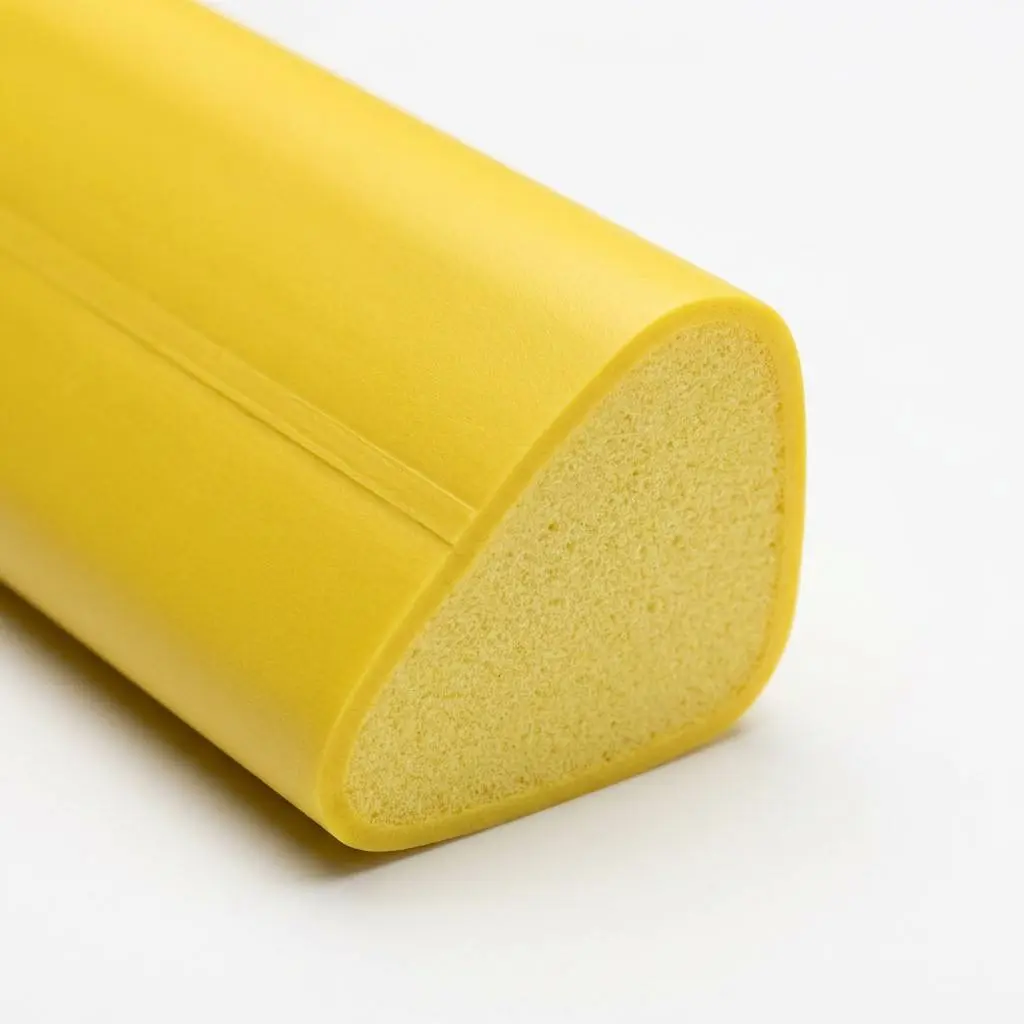
Polyurethane foam spans a wide performance envelope: flexible foam (18–80 kg/m³) for comfort cushioning, high-resilience (HR) foam for durable seating, memory foam for pressure distribution, self-skinning integral foam for structural handles and armrests, and microcellular PU (MCPU) for load-bearing jounce bumpers. PU is processable via pour, reaction injection, or press molding.
EVA Foam: Strengths & Limits
EVA (Ethylene-Vinyl Acetate) foam is low-cost, easy to process via compression molding or cutting, and available in consistent density grades. It excels in shoe midsoles, yoga mats, and simple protective packaging. Limitations: higher permanent compression set (45–60%) vs PU HR foam (15–25%); limited temperature range (−10°C to +70°C); cannot be molded into complex integral-skin geometries.
Application Decision Matrix
Choose PU foam when: complex 3D geometry is needed; self-skinning integral surface is required; fatigue life >500,000 cycles; EN1621 or ASTM F1815 impact certification is needed. Choose EVA when: flat/simple geometry; cost is the primary driver; color variety and transparency are needed (EVA accepts pigments easily); UV resistance is required (EVA has better UV stability).
Manufacturing Considerations
PU foam requires mixing equipment, molds, and temperature-controlled foaming ovens — higher tooling cost but complex part geometries. EVA foam uses simpler compression molds and cutting operations — lower tooling cost, higher volume. Blue Diamond offers both; for programs >20,000 pcs/year, PU molding typically achieves lower unit cost through material efficiency.