
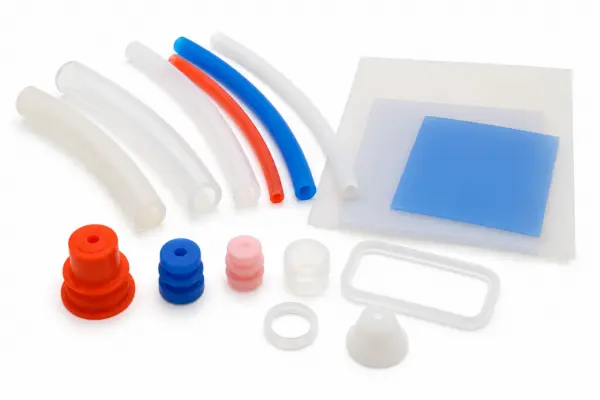
Silicone rubber (VMQ / Q) is a synthetic elastomer derived from polydimethylsiloxane (PDMS) — a polymer backbone of alternating silicon and oxygen atoms. Unlike petroleum-based rubbers, silicone maintains its physical properties across an extreme temperature range from -60°C to +200°C, making it indispensable for applications where standard elastomers would fail.
Key Chemical Properties
Silicone’s unique Si-O backbone is inherently non-polar and highly thermally stable. This gives it exceptional resistance to UV radiation, ozone, weathering, and a wide range of chemicals. Critically, platinum-cured silicone contains no sulfur, nitrogen, or metallic accelerators — making it compatible with human tissue and regulatory food-contact standards.
Temperature Performance
Standard VMQ silicone maintains elastic performance from -60°C to +180°C continuously, with short-term peaks to +230°C. Compared to EPDM (max +150°C) and NBR (max +120°C), silicone is the only elastomer suitable for engine bay seals, industrial ovens, and autoclavable medical equipment simultaneously.
FDA & Food-Grade Compliance
Platinum-cured liquid silicone rubber (LSR) meets FDA 21 CFR 177.2600 and EU Regulation 10/2011 for food contact. These grades are free of plasticizers, heavy metal catalysts, and extractable organotin compounds — critical for baby products, food processing equipment, and pharmaceutical dispensing systems.
Typical Silicone Components
Blue Diamond manufactures silicone O-rings, gaskets, slit valves, diaphragms, peristaltic tubing, keypads, baking molds, and overmolded seals. Tolerances achievable in LSR injection molding reach ±0.05mm for precision medical applications.